
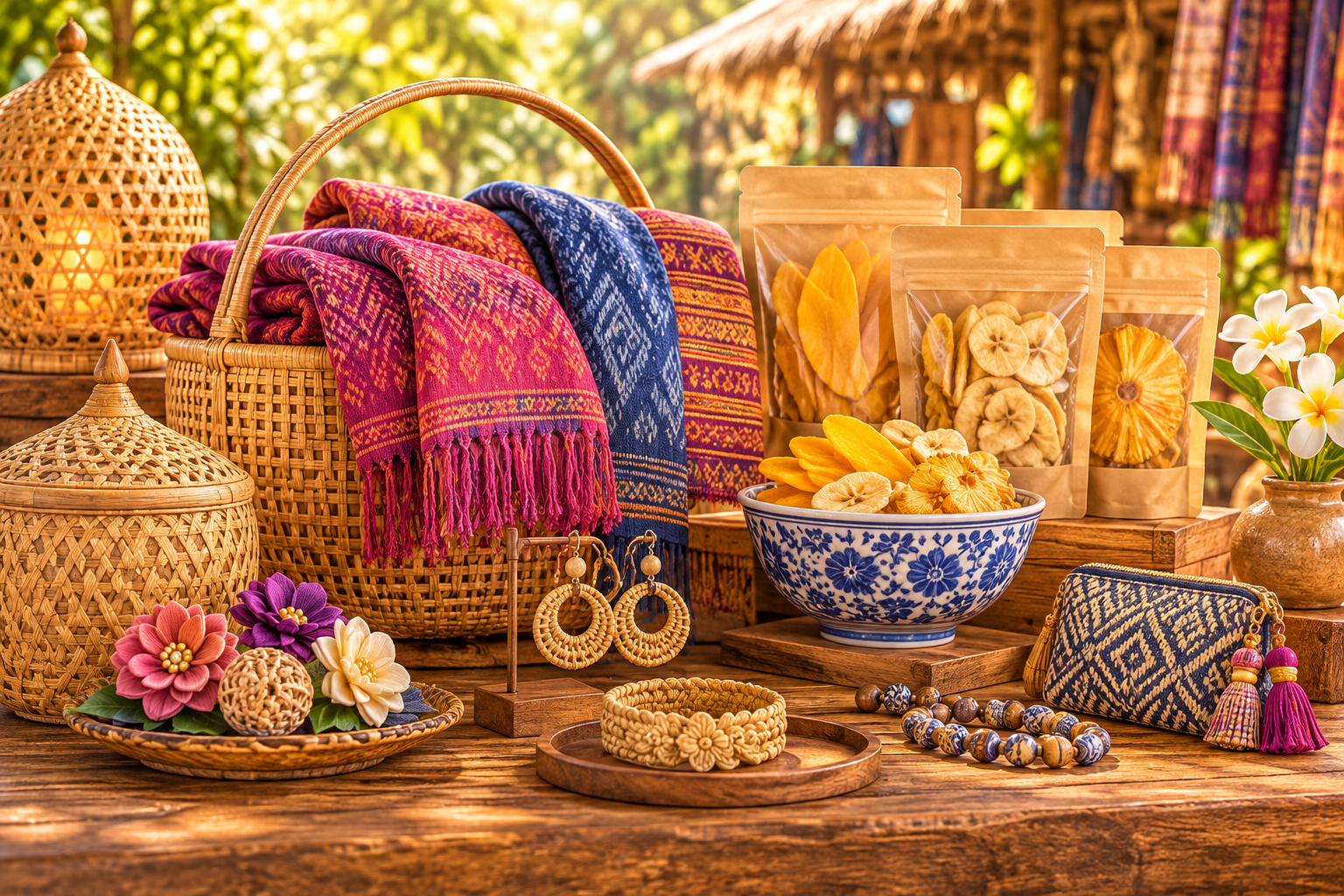
Thailand has plenty of easy-to-buy souvenirs, but shopping for something made by a local community takes a little more curiosity. Look for the letters OTOP—short for One Tambon One Product—and you will start noticing foods, textiles, homewares and gifts with roots in local skills and small enterprises.
The useful question is not simply “Is this a five-star OTOP product?” It is “Who made it, where did it come from, and is it something I will actually use?” Here is how to shop thoughtfully without confusing community-product recognition with a blanket safety or authenticity guarantee.
What does OTOP mean?
A tambon is a Thai subdistrict. The national One Tambon One Product programme began in 2001 and supports producers who draw on local resources, skills and traditions. The UN Food and Agriculture Organization (FAO) describes OTOP as a community-development programme that also helps producers reach markets through local outlets, fairs and other distribution channels.
In practice, OTOP is broader than souvenirs alone. FAO groups products into five types: food, beverages, textiles and apparel, decorative or souvenir products, and herbal products. That gives shoppers several ways to find a genuinely useful gift rather than another object that sits unopened in a cupboard.
Five useful things to look for
1. Packaged local foods
Dried fruit, preserved snacks, locally prepared condiments and other shelf-stable foods can be easy gifts. Check the complete packaging rather than trusting the front design: product identity, manufacturer information, allergens and dates matter. For commercially packaged foods, Thailand’s Food and Drug Administration provides requirements for Thai-language food labels and key consumer information.
If you are taking food abroad, check your destination country’s import rules before buying. OTOP recognition alone does not mean a food can be carried across a border.
2. Textiles you will really wear
Scarves, cloth bags and locally made apparel can be more useful than fragile ornaments. Ask what the fabric is made from, how it should be washed and whether the seller knows the producing group. Natural fibres, dyes and handmade methods vary, so do not assume every textile has the same care instructions.
Interested in a more specific craft destination? Thamai has a separate guide to Ban Thung Hong’s mo hom textile shops in Phrae.
3. Small homewares
A practical bowl, basket or decorative item can be a memorable purchase when you understand the maker’s story. Inspect edges, stitching and construction in person, and consider whether the item can survive the journey home. Fragile ceramics need better packing than a woven bag.
4. Community-made gifts
Some products are designed as gifts rather than daily essentials. Consider the recipient first. A small useful item with clear provenance may be more thoughtful than a large or expensive souvenir whose origin is unclear.
5. Local specialty products with a story
Ask which district or community a product represents. Do not assume a place name on a package is a legally protected origin designation. Thailand distinguishes OTOP from Geographical Indication (GI) products: GI involves formal registration of a name linked to an identified geographical origin, while OTOP is a separate community-product programme.
What do OTOP stars actually mean?
The OTOP Product Champion system classifies evaluated products into levels from one to five stars. According to FAO, the assessment considers factors such as consistent production, product standardization and quality, market potential, and community identity. A five-star classification signals a particular outcome in that programme’s assessment—not an all-purpose promise that the item is the best choice for every shopper.
Check the exact product and producer rather than assuming every item in a shop shares the same classification. A seller may offer products from several different makers and categories.
OTOP versus GI: a quick comparison
| Question | OTOP | GI |
|---|---|---|
| Main purpose | Promote community products and local enterprise | Protect product names associated with a specific geographical origin |
| Must a product be tied to a legally defined area? | Not in the same way as GI | Yes, under its registered specification |
| Does it automatically prove a product is safe for everyone? | No | No |
| Best shopping question | Who made this, and what local skill does it represent? | Is the name legitimately registered for this origin and product? |
These distinctions come from the Thai government explanation of OTOP and GI, which cites Thailand’s Department of Intellectual Property.
Where can you find OTOP products?
FAO describes distribution through community outlets, public markets, fairs, exhibition centres and shops in other public or private locations. Availability changes by region and event. It is better to look for an actual current seller or official listing than to assume every airport, market or shopping centre stocks the same products.
For a starting point, explore the Community Development Department’s OTOP information website. For a broader understanding of the programme, FAO’s Thailand OTOP overview explains the classification and responsible authorities.
A five-minute checklist before paying
- Identify the maker. Ask for the producer’s name, community or a verifiable label.
- Check the actual product. Look at the materials, packaging condition, size and care information.
- Read food labels carefully. Ingredients, allergens, storage and expiry information matter more than a souvenir badge.
- Compare value, not only the star rating. Think about usefulness, durability and a price you are comfortable paying.
- Keep a receipt. Useful if a product is damaged or you need to clarify a purchase later.
Is an OTOP product automatically authentic, premium or export-ready?
No single label answers all three questions. The programme promotes local enterprise and uses product assessments, but shoppers still need to check the specific goods, producer and any applicable food, cosmetics, textile or export requirements. Treat unusually strong claims—especially health claims—as something to independently verify, not an automatic consequence of an OTOP badge.
The takeaway
The most interesting Thailand souvenir may be the one you can explain in a sentence: who made it, what local tradition shaped it and why you chose it. That is a better shopping goal than buying the largest bag of anonymous gifts.
Information checked 22 November 2026. Product availability, current ratings and prices were not independently verified for individual sellers.