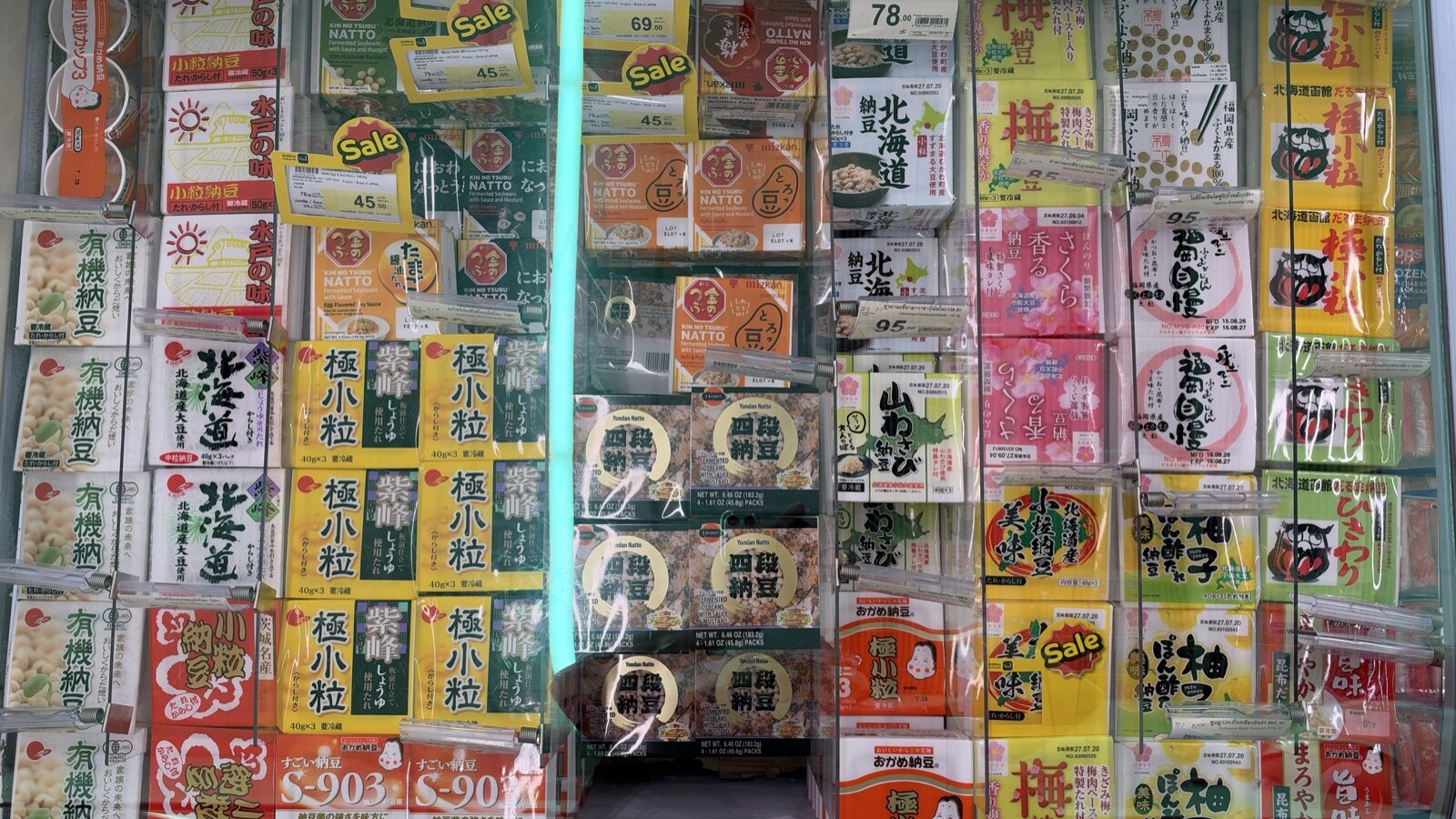
A wall of natto in the chiller
In the chilled section of a Thai supermarket, I found a whole wall of Japanese natto (納豆). The packs came in yellow, red, pink and green, with Japanese brand names and mascots. Many were small three-pack trays of 40–50 g each, and some were 4-packs. A few were marked “Sale”. Price tags I could read were 45, 69, 78 and 95 baht. Several tags are covered or blurry, so I can’t match each price to a specific pack.
What is natto?
Natto is a traditional Japanese food made from whole soybeans fermented with the bacterium Bacillus subtilis var. natto. It is often eaten for breakfast with rice. It has a strong smell, a sticky, stringy texture and a distinctive flavour, so many people consider it an acquired taste.
What the pack labels mean
- Small-bean types (小粒, 極小粒): smaller beans are preferred for natto because fermentation reaches the centre of the bean more easily.
- Tare and karashi (たれ・からし): most packs come with a soy-based sauce sachet and a small mustard sachet.
- Organic (有機): a few packs were labelled organic.
- Hokkaido (北海道): some packs mention Hokkaido-grown soybeans.
- Variations: flavoured sauces such as ume (plum) and yuzu ponzu also appear.
- Keep chilled: labels show a refrigerated-storage mark.
I only read the labels visible in the photo. Check each pack’s ingredients, origin and dates when you buy.
How to eat natto
- Open the pack and stir the beans until they turn sticky and stringy.
- Add the sauce, and the mustard if you like it.
- Serve on warm rice, with spring onion if you have it.
It can also go into miso soup, on toast or in tamagoyaki.
Nutrition and a caution
Per 100 g, natto is about 211 kcal with 19 g protein and 11 g fat. It is a rich source of copper, iron and magnesium, and of vitamin K2. Because of the vitamin K, people taking the blood thinner warfarin should talk to their doctor before eating it regularly.
FAQ
Does it smell?
Yes, it has a pungent smell.
Do I cook it?
No. It is eaten cold or at room temperature on warm rice.
Where do I find it in Thailand?
In the chilled aisle of some supermarkets, as in this photo. Availability varies by store.
Source: Natto, Wikipedia